PLAYER ZERO ✦
[TINY CHIPS]
BIG IDEAS ✦
A playful showcase of embedded systems projects, technical experiments, and things I enjoyed building.
▶ SELECT PROJECT OR SCROLL TO VIEW!!!
Ahsan Here!!!LV.25

MAIN QUEST
PROJECT ARCHIVE
DATA FLOW
[SYSTEM MAP]
SPEAK▼▶
STREAM▼▶
TRANSCRIBE▼▶
REFINE▼▶
ARCHIVE
01
Meet Pause ^_^
A physical voice-journaling companion that turns unfiltered thoughts into an organized personal archive.
Pause is a physical voice-journaling companion designed to make reflection effortless.
- With the press of a button, the user can speak naturally without worrying about structure or perfect wording.
- Pause preserves the original voice recording in Google Drive and transforms the conversation into a polished journal entry in Notion.
- Animated OLED expressions give the physical device a subtle personality, making it feel more like a quiet companion than a conventional voice recorder.
[TECHNICAL IMPLEMENTATION]
Built around an ESP32 and an I²S MEMS microphone, Pause streams audio over Wi-Fi to a Python and Flask backend. OpenAI Whisper performs speech-to-text transcription, while Groq restructures the raw transcript into clear, expressive prose without changing its meaning. The original recording is stored in Google Drive and the journal entry is saved to Notion—combining embedded hardware, networked audio, AI processing, cloud storage and API integrations.
◖•ᴗ•◗▁▃▆▃▁🎙♡REC ●
- [MCU]
- ESP32
- [AUDIO]
- I²S MEMS Microphone
- [DISPLAY]
- OLED
- [NETWORK]
- Wi-Fi / Audio Streaming
- [BACKEND]
- Python / Flask
- [AI]
- Whisper / Groq
- [CLOUD]
- Google Drive / Notion
02
10×10 Raspberry Pi Camera Array for Lightfield Acquisition
Supported the network infrastructure of a 100-node Raspberry Pi camera array designed for synchronized lightfield acquisition and experimental multi-camera research.
- Configured network protocols and static IP addressing across the 10×10 Raspberry Pi camera array.
- Set up and configured individual Raspberry Pi units within the distributed embedded system.
- Ensured consistent network connectivity across the array for synchronized multi-camera capture.
- Produced infrastructure and network architecture diagrams to document and communicate the system topology to the research team.
Worked on the embedded network infrastructure for a 10×10 Raspberry Pi camera array. My contribution focused on configuring and maintaining the distributed Raspberry Pi nodes so the array could communicate reliably during synchronized multi-camera capture.
[PAPER REFERENCE]
Near, Far, Wherever You Are: A Multi-Camera Array using a Modifiable Layout for Lightfield Acquisition
- [PLATFORM]
- Raspberry Pi
- [SCALE]
- 10 × 10 Nodes
- [NETWORKING]
- Static IP / Network Configuration
- [SYSTEM]
- Distributed Camera Array
- [DOMAIN]
- Lightfield Acquisition
- [ROLE]
- Research Internship
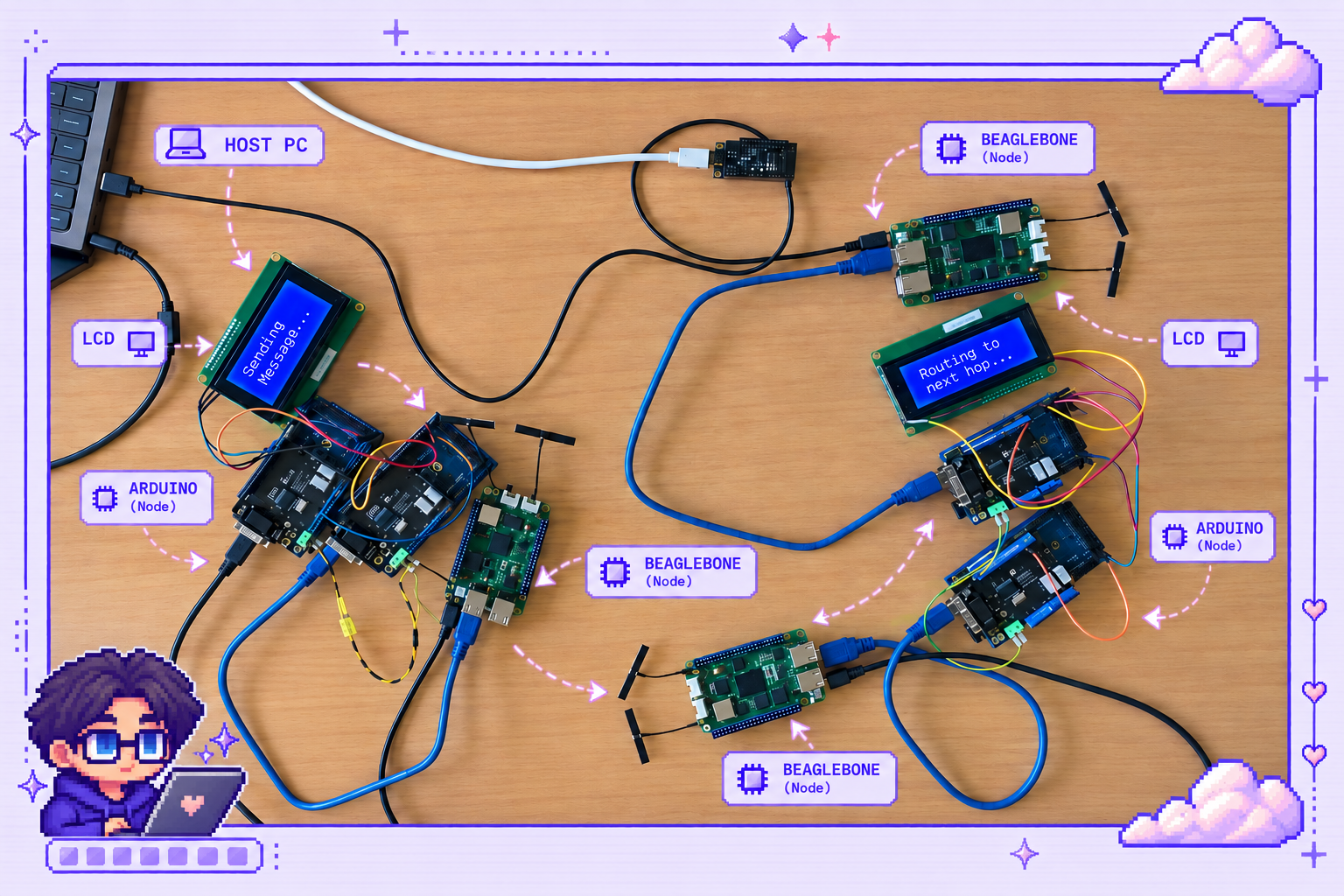
DATA FLOW
[SYSTEM MAP]
ARDUINO▶ARDUINO▶BEAGLEBONE
▼WI-FI / TCPBEAGLEBONE▶ARDUINO▶ESP32 ✦
03[PROJECT 03] [NETWORK QUEST]
Multi-Hop Embedded Communication & Real-Time Analysis
Built and analyzed a multi-device embedded communication network connecting Arduino, BeagleBone and ESP32 platforms across wired and wireless links. The system forwarded messages through multiple embedded nodes using UART, Wi-Fi/TCP and Bluetooth, then measured communication behaviour and timing across the complete network.
- Implemented a bidirectional multihop communication chain across Arduino, BeagleBone and ESP32 devices.
- Used UART for serial links, Wi-Fi/TCP for wireless networking and Bluetooth RFCOMM for the return communication path.
- Measured an end-to-end round-trip time of approximately 3 seconds across the complete chain.
- Extended the experiment with CPU-intensive load to observe how processor scheduling affected communication latency.
- Investigated priority inversion using FreeRTOS with high-, medium- and low-priority tasks sharing a resource.
- Compared a binary semaphore with a mutex using priority inheritance to show how scheduling affects time-critical tasks.
- [PLATFORMS]
- Arduino / BeagleBone / ESP32
- [NETWORK]
- UART / Wi-Fi / TCP / Bluetooth
- [RTOS]
- FreeRTOS
- [ANALYSIS]
- Latency / Scheduling
- [CONCEPTS]
- Priority Inversion / Inheritance
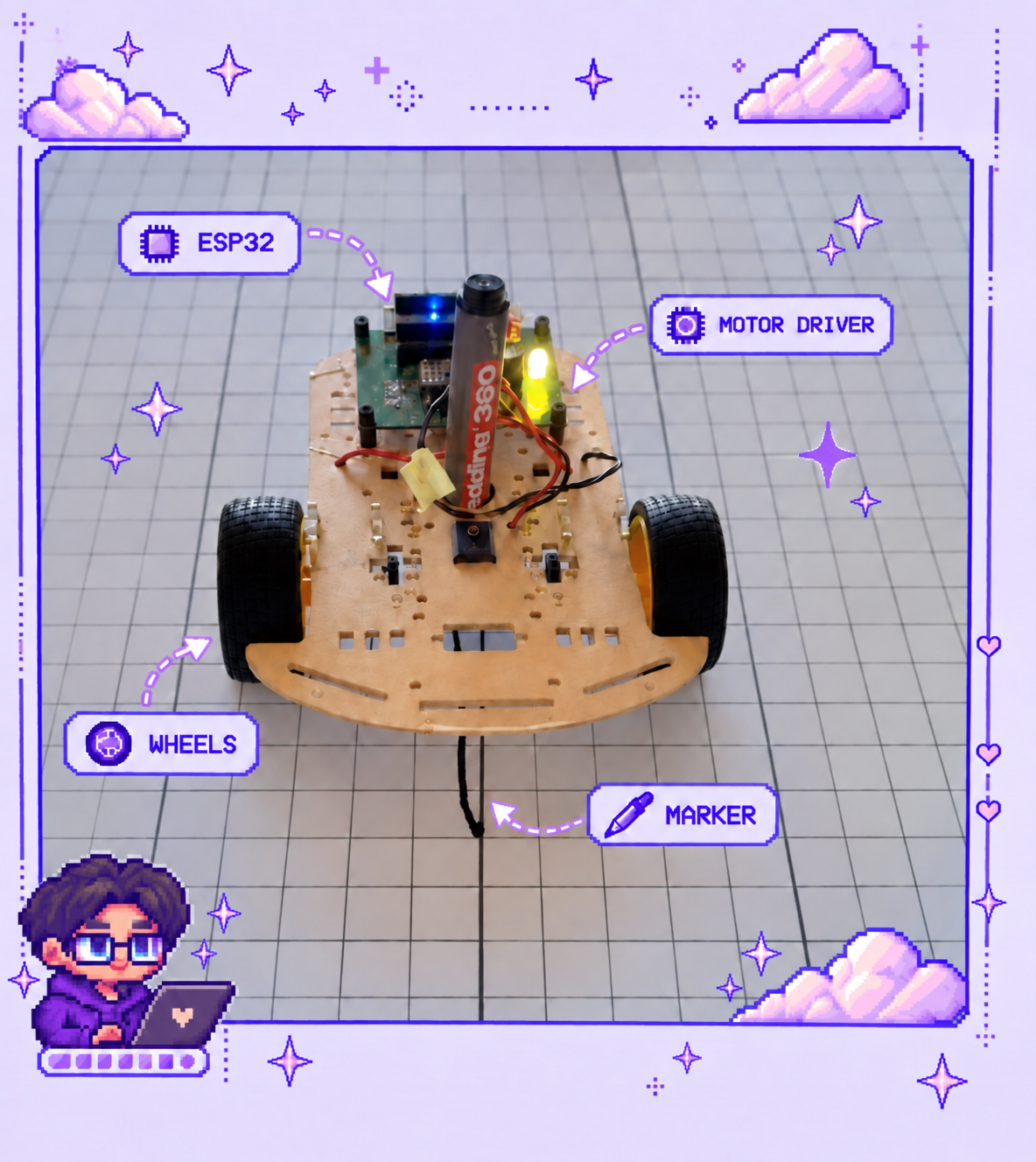
DATA FLOW
[SYSTEM MAP]
LAPTOP▼ARDUINO▼BEAGLEBONE▼ESP32▼PWMROBOT□ SQUARE△ TRIANGLE○ CIRCLE▭ RECT
04
Remote-Controlled Embedded Robot
Developed a remotely controlled mobile robot where high-level movement commands travelled through a multi-device embedded network from a laptop, via Arduino and BeagleBone boards, to an ESP32 on the robot.
- The ESP32 interpreted commands locally and drove four shape routines — square, triangle, circle and rectangle — using PWM motor control.
- Two independently driven DC motors ran without encoders or an IMU, so the motion system was fully open-loop.
- Speeds and turn durations were calibrated experimentally to compensate for drift, friction and accumulated motion error.
- [MCU]
- ESP32
- [NETWORK]
- CAN / UART / Wi-Fi / TCP
- [CONTROL]
- PWM Motor Control
- [MOTION]
- Open-Loop Control
- [HARDWARE]
- DC Motors / Motor Driver
- [TESTING]
- Experimental Calibration
PLAYER INFO
STATUS: CURIOUS ✦
SAVE SLOT / 001
[ABOUT ME]
I enjoy building things that connect code, hardware, and ideas — especially when I can understand how they work from the inside out.
FIRMWAREELECTRONICSPROTOTYPING
![[DEVICE PHOTO // 01]](/__l5e/assets-v1/cb1c909b-dbc4-4a3c-8dca-bc0610eacc87/project-04-device.png)
![[PROJECT IMAGE // 02-A]](/__l5e/assets-v1/bd2d0f4f-2e96-42e9-9123-2b10c7a832cd/project-03-array-side.png)